What is the lowest down payment available in New Braunfels?
The lowest down payment in New Braunfels depends on which loan you qualify for. VA and USDA loans allow 0% down for eligible buyers. Conventional loans can start at 3% down with strong credit. FHA sits at 3.5% down with a credit score of 580 or higher.
VA is limited to active-duty military, veterans, and some surviving spouses. USDA is income-capped and only works on properties in USDA-eligible rural zones, which excludes most of the New Braunfels city core but covers plenty of Comal and Guadalupe County land outside it. USDA zero-down loans are only for eligible rural areas and income-qualified buyers, so the property has to qualify too.
Conventional at 3% usually requires a 620+ score and steady employment history. FHA at 3.5% is the common path for first-time buyers who do not have a huge cash reserve. If your credit score lands between 500 and 579, FHA still works but requires 10% down.
Every path has tradeoffs. Lower down means higher monthly insurance. Check the Buyer’s Guide for a walkthrough before you commit to one loan type.
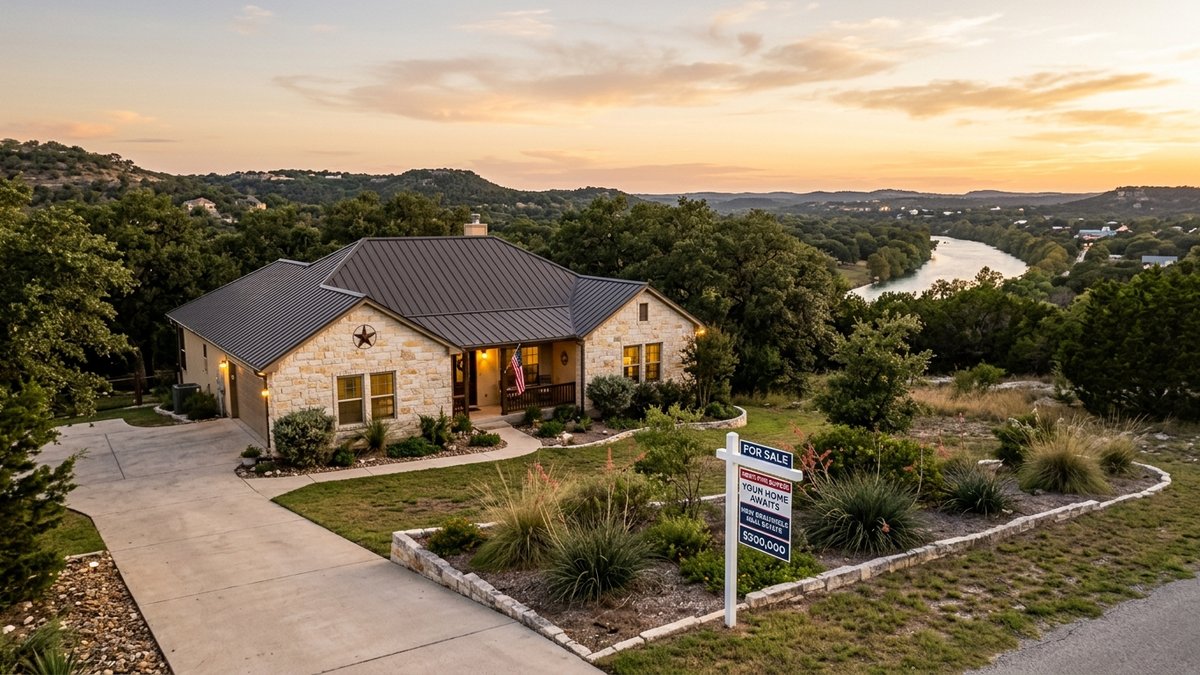
How much cash do you actually need to close on a $300,000 home?
The down payment is only part of the cash you bring to closing. A typical New Braunfels closing package for a first-time buyer includes down payment, closing costs, prepaid property taxes and insurance, inspection fees, and a small reserve.
On a $300,000 home, down payment ranges roughly from $0 on VA or USDA, to $9,000 on conventional at 3%, to $10,500 on FHA at 3.5%. Closing costs in Texas typically run 2% to 5% of the purchase price, so add another $6,000 to $15,000. Prepaids cover 6 to 12 months of homeowners insurance and 2 to 14 months of property taxes held in escrow.
Inspections usually run $400 to $800 for a general inspection, plus optional termite, septic, well, or pool inspections if the property has them. Title policy and survey typically add another $1,500 to $2,500 combined. Lender origination and underwriting fees can add $1,200 to $2,500 on top. Most first-time buyers underestimate total cash to close because they focus only on the down payment number and forget about everything else on the settlement statement.
Run the numbers through the mortgage calculator before you start showings. Knowing your real cash-to-close number keeps the search realistic and keeps you from writing offers you cannot actually close.
When do first-time buyers have to pay PMI?
If you put less than 20% down on a conventional loan, you pay PMI. PMI continues until you reach roughly 20% equity in the home, either from paying down the loan or from appreciation. Once you cross that line, you can request PMI removal.
FHA works differently. FHA borrowers pay MIP, not PMI. MIP includes an upfront premium rolled into the loan, plus a monthly premium. For most FHA loans originated today with less than 10% down, MIP stays for the life of the loan. The only way to drop FHA MIP is to refinance into a conventional loan after you build equity.
That detail matters. Two buyers with the same down payment on the same house can pay very different mortgage insurance totals over time depending on whether they went FHA or conventional.
Conventional PMI costs usually run 0.3% to 1.5% of the loan balance per year, billed monthly. FHA MIP runs around 0.55% of the loan balance per year for most first-time buyer loans. Talk to two or three lenders and compare both the rate and the mortgage insurance side by side.
How do seller concessions change the math?
Seller concessions are money the seller agrees to credit at closing to help cover your closing costs or buy down your interest rate. For a primary home with less than 10% down, seller concessions are capped at 3% of the purchase price on most loan types. On a $300,000 home, that is up to $9,000.
With more than 10% but less than 25% down, the cap rises to 6%. At 25% or more, it goes to 9%. VA loans have their own rules, generally capped at 4% for concessions plus unlimited seller-paid closing costs.
In the New Braunfels market today, concessions are often on the table, especially on homes that have sat longer than a month. A 3% concession can either cover most of your closing costs or fund a temporary rate buydown that drops your payment for the first year or two.
Bring this up with your agent before writing an offer. If the listing has been sitting, asking for concessions is normal negotiation, not an insult. Want to discuss how to structure your offer in this market? Contact Glen for a straight answer.
What down payment assistance is available in Texas?
Texas runs several first-time buyer programs through TSAHC down payment assistance. TSAHC offers grants and second-lien loans that cover the down payment and closing costs on FHA, VA, USDA, and conventional loans. Most programs are income-based and require a homebuyer education course.
One path is the Home Sweet Texas Home Loan Program, which layers assistance onto a fixed-rate mortgage. Another is the Homes for Texas Heroes program, available to teachers, police, firefighters, EMS, and veterans, with similar terms but different income limits.
Local New Braunfels lenders often know which stacked programs work best for the property you are looking at. Not every home qualifies, and not every lender participates. Ask up front.
Beyond state programs, look at lender-specific grants. Some banks offer their own down payment assistance of 1% to 3% of the purchase price for qualified buyers. These programs change often, so confirm current terms before you rely on them.
If you are relocating to New Braunfels from out of state, the Relocation Guide has a rundown of what to line up before you arrive. Good planning before you ever see a house saves weeks later.